Concurrent Delay In Force Majeure Cases: A Delay Expert’s Perspective
Concurrent Delay in Force Majeure Cases: Understanding EOT, Costs, and Contractor Risk
This article explores the complex issue of concurrent delay in construction projects, particularly where Force Majeure events overlap with Employer or Contractor Risk events. It examines how industry guidance, standard contracts, and UK case law interpret concurrent delay, including the well-known Malmaison Approach. The piece also highlights the challenges contractors face in claiming Extension of Time (EOT), recovering prolongation costs, and avoiding liquidated damages during concurrent delay scenarios. Additionally, it provides practical recommendations on record-keeping, notices, and programme updates to strengthen future claims.
Frequently Asked Questions
Get answers to frequently asked questions about everything we do.
What is concurrent delay in construction projects?
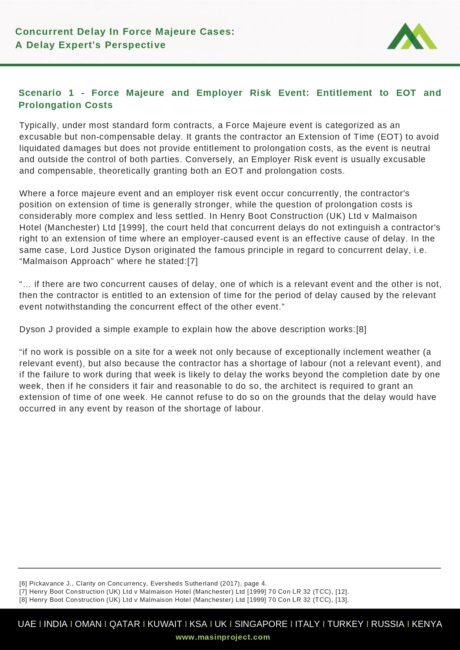
Concurrent delay occurs when two or more delay events impact the project at the same time, and each event independently affects the project completion date. These delays may involve Employer Risk Events, Contractor Risk Events, or Force Majeure events.
Does a Force Majeure event entitle a contractor to an Extension of Time (EOT)?
Yes. Under most standard contracts, Force Majeure is treated as an excusable but non-compensable delay, meaning contractors are generally entitled to an EOT to avoid liquidated damages, although prolongation costs are usually not recoverable.
Can contractors recover prolongation costs during concurrent delays involving Force Majeure?
Recovering prolongation costs during true concurrency is difficult. Courts and tribunals often apply the “but-for” test, meaning contractors must prove that the Employer Risk Event alone caused the additional costs, independent of the Force Majeure event.
What is the Malmaison Approach in concurrent delay claims?
The Malmaison Approach, established in Henry Boot Construction v Malmaison Hotel, states that if one of the concurrent causes of delay is a relevant event, the contractor is generally entitled to an EOT, even if another concurrent delay is caused by the contractor.
What practical steps should contractors take during Force Majeure events?
Contractors should maintain detailed daily reports, progress photographs, resource logs, updated programmes, and comply strictly with contractual notice requirements. Robust contemporaneous records are essential for supporting EOT claims and defending against allegations of concurrent delay.