Force Majeure and Delay: A Causation Problem Disguised as Law
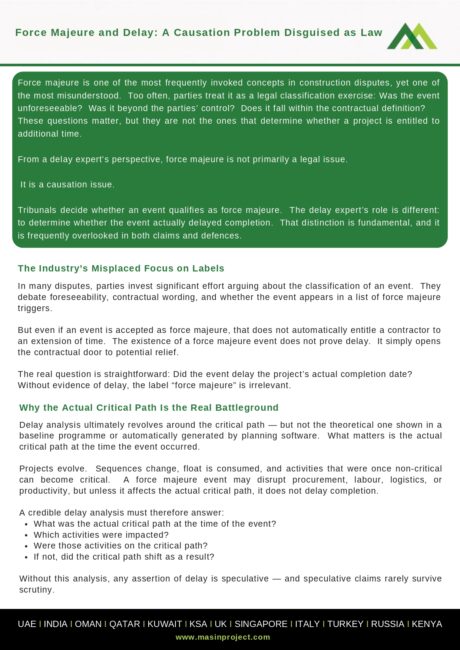
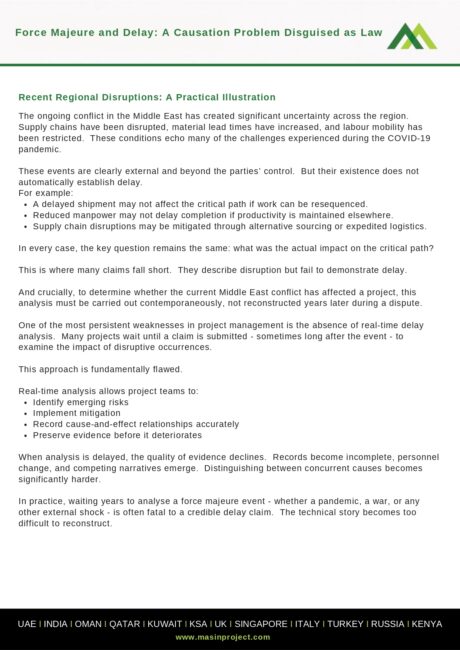
Force Majeure and Delay: Why Causation Matters More Than Classification
This article explores how force majeure claims in construction disputes are often misunderstood as purely legal issues, when in reality they are fundamentally questions of causation. It argues that simply proving the existence of a force majeure event — such as war, COVID-19 disruptions, or supply chain failures — is not enough to justify an extension of time. The critical issue is whether the event actually impacted the project’s critical path and delayed completion. Through practical examples and arbitration insights, the article highlights the importance of contemporaneous delay analysis, robust project records, and evidence-based assessments. It concludes that successful delay claims depend not on labels, but on proving a clear causal link between the disruptive event and project delay.
Frequently Asked Questions
Get answers to frequently asked questions about everything we do.
What is force majeure in construction disputes?
Force majeure refers to extraordinary events beyond the parties’ control — such as wars, pandemics, or natural disasters — that may affect project performance and potentially entitle a contractor to relief under the contract.
Does a force majeure event automatically entitle a contractor to an extension of time?
No. A contractor must still prove that the event actually delayed the project’s completion and impacted the critical path of the works.
Why is critical path analysis important in force majeure claims?
Critical path analysis helps determine whether the disrupted activities were directly affecting the project’s completion date. Without demonstrating impact on the actual critical path, delay claims may fail.
What is the role of a delay expert in force majeure disputes?
A delay expert assesses whether the event caused delay from a technical and scheduling perspective. Their role is to establish causation and quantify delay using contemporaneous evidence and project records.
Why is contemporaneous delay analysis essential?
Real-time delay analysis helps preserve evidence, identify impacts early, and accurately demonstrate cause-and-effect relationships. Delayed analysis often weakens claims because records deteriorate and project conditions become harder to reconstruct.